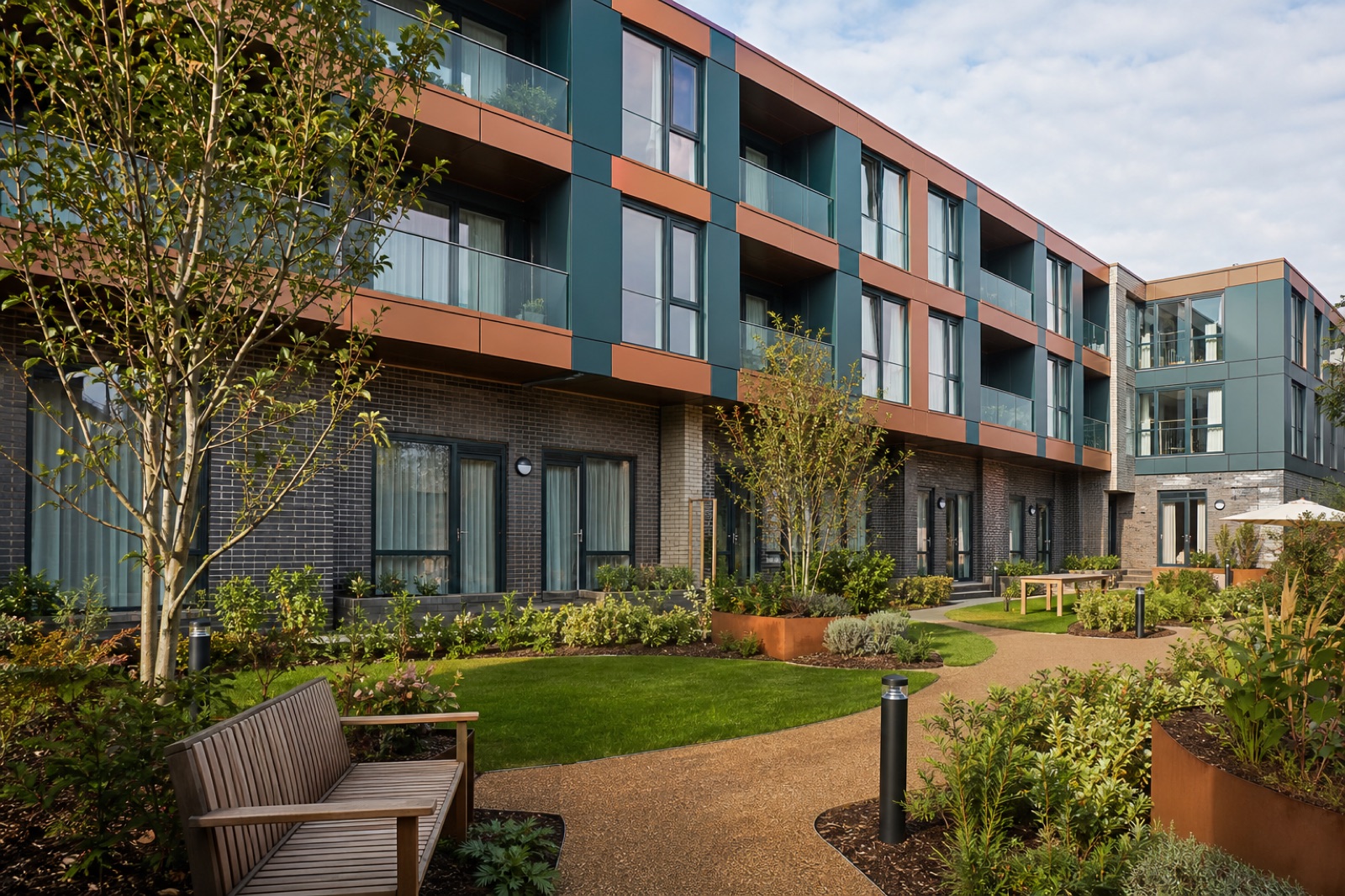
Supported and assisted living stabilisation finance
We arrange stabilisation finance for developers and investors carrying a completed supported or assisted living scheme through provider sign-up and tenant placement to a fully-let income. A scheme needs a registered care provider and tenants in place before its long lease delivers stabilised income, so this is the short-dated bridge across that gap, not a regulated home loan or a personal loan.

Stabilising supported living
Supported and assisted living is specialist housing for people who need care or support to live independently, let on long, often index-linked leases that sit inside the broader Living sector. It is data-poor at sector level: supported housing is not separately broken out, with the whole UK Living sector recording about £3.2bn of investment in Q3 2025, up 60% quarter on quarter (Knight Frank), and CBRE recording £4.3bn of UK Living in the first half of 2025. Agents do not publish a clean supported-living yield, so the sector is read qualitatively, through strong private-capital appetite on a demand and supply imbalance, index-linked rents and ESG credentials.
Supported living stabilisation finance is the short-dated bridge that carries a completed scheme from practical completion through provider sign-up and tenant placement to a fully-let, income-producing asset. A newly developed scheme needs a registered care provider in place and tenants placed before its long index-linked lease delivers stabilised income, so the income does not switch on at completion. Stabilisation finance funds that gap between completion and a let, income-producing scheme.
The financing question turns on getting the provider and tenants in place, not on any one borrower's personal circumstances. Lenders read the strength and registration of the care provider taking the lease, the lease structure and its index-linking, the route to placing tenants and drawing down the income, and the gap between the day-one value and the stabilised value the let, contracted income supports. They size against loan to value before the lease is income-producing, the income the contracted lease will deliver, and interest cover, with a clear exit onto investment or long-income debt once the scheme is let.
We package the scheme, the care provider and the lease so lenders comfortable with supported housing and the Living sector can price the route to income, and we run the market across stabilisation, development exit and investment term lenders rather than approaching a single bank.
What we fund
- Newly completed supported-living schemes awaiting tenant placement
- Assisted living schemes signing up a registered care provider
- Specialist supported housing on a long index-linked lease
- Schemes placing tenants ahead of a long-income refinance
- Repositioned schemes proving a new provider lease and income
- Standing let supported-housing assets being refinanced
Indicative terms
- Loan to value before incomeCommonly around 65 to 75% of value
- TermShort-dated through provider sign-up and tenant placement
- Income basisLong, often index-linked lease once let and contracted
- CovenantRegistered care provider covenant assessed
- Interest coverTested against contracted lease income; part-serviced if needed
- Key testsProvider strength, lease, tenant placement, ESG credentials
- ExitInvestment or long-income refinance, or sale, once let
Indicative only. Terms vary by lender, asset and scheme and are not an offer of finance.
How we arrange supported living finance to a let scheme
We arrange supported living finance around provider sign-up and tenant placement, and pre-agree the exit. For a completed scheme, we place stabilisation finance commonly to around 65 to 75% of value, short-dated across the period to a fully-let asset, sized on the contracted income the long lease will deliver once the provider and tenants are in place. Where the scheme has just been built, development exit finance repays the development facility and gives time to sign up a registered provider and place tenants without a construction loan running on. Because the income switches on only when the lease is income-producing, interest is often part-serviced or rolled in the interim. Where workable senior debt is already in place, we can instead structure a second-charge facility behind it to fund the period to a let scheme, subject to the senior lender's consent, rather than refinancing the whole position. We pre-agree the route onto an investment or long-income term loan, or a sale, once the scheme is let. We frame every figure as indicative and never as an offer; the terms depend on the scheme, the care provider and the lease.
What lenders assess on a scheme reaching income
Lenders underwrite a supported living scheme on the strength and registration of the care provider taking the lease, the lease structure and its index-linking, the route to placing tenants and drawing the income, and the gap between day-one and stabilised value, then size against loan to value, the contracted income and interest cover. They want a credible registered provider and a clear path to a let, income-producing scheme, because the long index-linked lease and the provider covenant are what underwrite the loan and the exit. Private capital appetite for the Living sector is strong, which deepens the pool of long-income lenders and buyers, but the route to income is the key risk before the lease is live. As a broker with no exclusive tie, we present the provider and the lease honestly and place the case with the lender most comfortable with supported housing. We arrange the finance; we do not lend, and we are not FCA-authorised because this is unregulated commercial lending.
From completion to a contracted income
A supported living scheme's exit rests on reaching a let, income-producing state, after which it refinances onto investment or long-income debt or sells. Because the sector is data-poor and not separately broken out, the relevant evidence is the Living sector backdrop, about £3.2bn of UK Living investment in Q3 2025, up 60% quarter on quarter (Knight Frank), and £4.3bn in the first half of 2025 (CBRE), plus strong private-capital appetite on a demand and supply imbalance, index-linked rents and ESG credentials. A long index-linked lease to a strong registered provider prices close to long-income property once it is live. Once the scheme is let, we term out the bridge onto a senior investment or long-income loan sized on the contracted income, or arrange a cash-out refinance to release equity. For a stabilisation lender, that clear route from completion to a contracted, refinanceable income is what supports the loan on day one.
Finance that suits this asset class
- Stabilisation bridge financeCarries the scheme through provider sign-up and tenant placement.
- Development exit financeRepays the construction loan while the scheme reaches income.
- Bridge-to-term financeStructures the move from the bridge onto long-income debt.
- Senior investment term loansLong-income debt sized on the contracted lease once let.
- Cash-out refinanceReleases equity from a let scheme into the next development.
Stabilising supported living?
A view on fundability within one working day.
Frequently asked questions
How is a supported living scheme financed before it is let?
Usually with a short-dated stabilisation bridge, commonly to around 65 to 75% of value, that carries the scheme from completion through signing up a registered care provider and placing tenants. Because the income switches on only when the long lease is live, interest is often part-serviced in the interim. Where the scheme has just been built, development exit finance repays the construction loan first. The exit is onto an investment or long-income loan once the scheme is let.
What do lenders look for in supported and assisted living finance?
Lenders look for a credible, registered care provider taking the lease, a long, often index-linked lease structure, and a clear route to placing tenants and drawing the contracted income. They size against loan to value, the contracted income and interest cover, with the provider covenant central, because the live lease is what underwrites the loan. We present the provider and the lease and place the case with a lender comfortable with supported housing.
Is supported living finance a regulated home loan?
No. We arrange commercial property finance for the developers and investors who build and own supported and assisted living schemes: the stabilisation bridge to a let scheme and the long-income debt that refinances it. That is separate from how a resident's own support is funded, which involves housing benefit, universal credit and local authority arrangements and is not something we advise on. The finance we arrange is unregulated commercial lending against the asset and its lease.
When does a supported living scheme reach stabilised income?
A scheme reaches stabilised income once a registered care provider has taken the lease and tenants are placed, so the long, often index-linked lease is live and producing a contracted income. That is the point at which an investment or long-income lender will size long-term debt on the lease, allowing the stabilisation bridge to be refinanced or the scheme to be sold into the strong private-capital appetite for the Living sector.
What are the disadvantages of supported living?
From an owner's perspective the risks sit in the operator and the void period. Income depends on a registered provider taking and honouring the lease, so a weak covenant, a slow registration or a gap between practical completion and placements leaves the asset finished but not earning, and the specialist fit-out narrows the alternative-use market if the operator fails. Those are exactly the risks the lending has to carry through stabilisation, which is why lenders test the provider and the commissioning demand as hard as the property.
Is this a bridging loan?
In substance, yes. Supported living stabilisation finance is a specialist commercial bridging loan: short-dated, secured on the scheme, and structured to be repaid by a long-income refinance or sale once the lease is live, rather than out of personal income. What sets it apart from a generic bridge is that it is built around provider sign-up and tenant placement, with the term, the part-serviced interest and the exit set to the route to a contracted income. It can sit as a first charge or, where senior debt stays in place, as a second charge behind it. We arrange that finance; this is unregulated commercial lending.
Stabilising supported living?
Tell us about the asset and the income plan and we will come back with a view on fundability and likely terms.