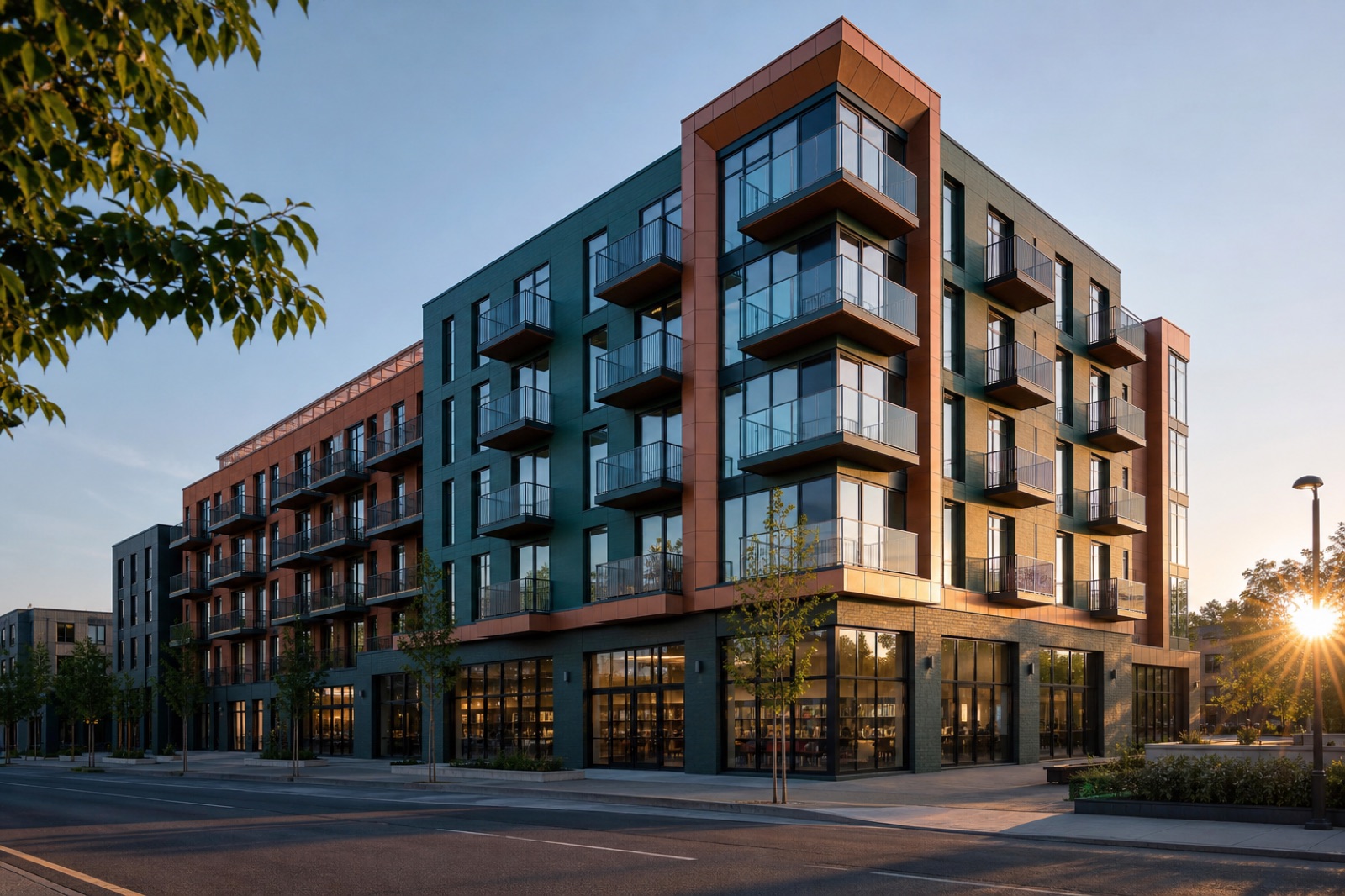
Mixed-use scheme stabilisation finance
We arrange stabilisation finance for developers and investors carrying a mixed-use scheme through the lease-up of each use to a stabilised whole-scheme income. A mixed-use scheme completes in phases and reaches stabilised income only as each use leases up, so this is the short-dated bridge across that gap, not a regulated home loan or a personal loan.

Stabilising mixed-use
A mixed-use scheme combines two or more uses in one development or asset, commonly residential over commercial, retail with build-to-rent, or a regeneration block blending workspace, leisure and homes. The residential element is often held as a multi-unit freehold block (MUFB) above the commercial floors, which shapes how a valuer and a lender read the whole. Mixed-use is treated as a strategy rather than a discrete tracked asset class: no major agent publishes a clean mixed-use prime yield, so the nearest sourced proxy is the UK all-property prime average near 5.75% (Savills, 2025), which should be read as a proxy rather than a sector-specific figure.
Mixed-use stabilisation finance is the short-dated bridge that carries a scheme from practical completion through the lease-up of each use to a stabilised whole-scheme valuation. A mixed-use scheme completes in phases and reaches stabilised income only once each use leases up, often on different timelines, so the whole-scheme income and value build rather than switching on at completion. Stabilisation finance funds that multi-use lease-up before institutional term debt will refinance.
The financing question turns on the lease-up of each use and the blended income they produce, not on any one borrower's personal circumstances. Lenders read the lease-up of the residential, commercial and any other element, the rents and lease terms achieved across each use, the way a valuer treats the blend, and the gap between the day-one value and the stabilised whole-scheme value. They size against loan to value during lease-up, the debt yield the building income produces, and interest cover, with a clear exit onto investment debt or a sale once each use is let and the scheme is stabilised.
We package the scheme, the lease-up of each use and the blended income so lenders can price the multi-use lease-up risk, and we run the market across stabilisation, development exit and investment term lenders rather than approaching a single bank.
What we fund
- Residential-over-commercial blocks leasing up each use
- Retail and build-to-rent regeneration schemes stabilising
- Workspace, leisure and residential regeneration blocks
- Repositioned retail with a new residential or BTR element
- Phased mixed-use developments handing over in stages
- Standing mixed-use assets being refinanced off development debt
Indicative terms
- Loan to value during lease-upCommonly around 65 to 75% of value
- TermShort-dated, typically 12 to 36 months through lease-up
- Income basisBlended income building as each use lets
- Debt yieldTested against the whole-scheme income as it builds
- Interest coverTested against blended net income; part-serviced if needed
- Key testsLease-up of each use, rents, lease terms, valuation blend
- ExitInvestment term refinance or sale at whole-scheme stabilisation
Indicative only. Terms vary by lender, asset and scheme and are not an offer of finance.
How we arrange mixed-use finance through a phased lease-up
We arrange mixed-use finance around the lease-up of each use and pre-agree the exit. For a newly completed scheme, we place stabilisation finance commonly to around 65 to 75% of value, short-dated across the lease-up window, sized on the blended income today and its trajectory to a stabilised whole-scheme income. Where the scheme has just been built, development exit finance repays the development facility and gives each use room to let without a construction loan running on. Because the uses let on different timelines, lenders test debt yield and interest cover against the blended income as it builds, part-servicing interest where the early income does not yet cover it. Where workable senior development debt is already in place and the borrower needs only to fund the remaining lease-up, we can structure a second-charge facility behind it rather than refinancing the whole stack, subject to the senior lender's consent. We pre-agree the route onto an investment term loan or a sale once each use is let and the whole-scheme valuation is proven. We frame every figure as indicative and never as an offer; the terms depend on the scheme, the lease-up of each use and how the valuer treats the blend.
What lenders weigh on a multi-use scheme
Lenders underwrite a mixed-use scheme on the lease-up of each use, the rents and lease terms achieved across residential, commercial and any other element, and the gap between day-one and stabilised whole-scheme value, then size against loan to value, debt yield and interest cover. They pay particular attention to how a valuer treats the blend, because a heavily commercial scheme is read differently from a residential-led one, and to whether the weaker use drags the whole. They also want each use letting at or ahead of plan, since the blended income underwrites the loan and the exit. As a broker with no exclusive tie, we present the lease-up of each use and the blended income honestly and place the case with the lender most comfortable with mixed-use risk. We arrange the finance; we do not lend, and we are not FCA-authorised because this is unregulated commercial lending.
From phased lease-up to a whole-scheme income
A mixed-use scheme's exit rests on stabilising the whole-scheme income, after which it refinances onto investment debt or sells. Because no agent publishes a discrete mixed-use prime yield, the nearest sourced proxy is the UK all-property prime average near 5.75% (Savills, 2025), and the real value is set by how the let blend is treated: a strong residential or build-to-rent element can price keenly, a weak retail element can drag, and the valuer weighs the mix. Once each use is let and the whole-scheme income is proven, we term out the bridge onto a senior investment loan sized on the blended income, or arrange a cash-out refinance to release equity. For a stabilisation lender, that clear route from a phased lease-up to a refinanceable whole-scheme income is what supports the loan to value on day one.
Finance that suits this asset class
- Stabilisation bridge financeCarries the scheme through the lease-up of each use to a stabilised income.
- Development exit financeRepays the construction loan while each use lets up.
- Lease-up financeFunds the gap while the blended income builds across uses.
- Senior investment term loansLong-term debt once the whole scheme is let and stabilised.
- Mezzanine and preferred equityTops up the capital stack where senior debt stops short.
Stabilising mixed-use?
A view on fundability within one working day.
Frequently asked questions
Can I get a mortgage on a mixed-use property?
A mixed-use property is financed as commercial or semi-commercial property, not on a standard residential mortgage, because the income blends residential and commercial uses. On a newly completed scheme still letting up, stabilisation finance bridges the lease-up of each use to a stabilised whole-scheme income, after which a term lender can refinance on the proven blend. We arrange that commercial finance against the asset and its income.
What qualifies as a mixed-use property?
A mixed-use property combines two or more uses in one asset, commonly residential over a commercial ground floor, retail with build-to-rent above, or a regeneration block blending workspace, leisure and homes. It is valued and financed on the blend of those uses, which is why a newly completed scheme uses stabilisation finance through the phased lease-up before a long-term refinance on the stabilised whole-scheme income.
Do you pay stamp duty on a mixed-use property?
Mixed-use property is generally taxed under the non-residential or mixed stamp duty rates rather than the residential rates, but the position depends on the specific scheme and is a matter for a tax adviser or conveyancer, not a finance broker. What we arrange is the finance against the asset and its income: stabilisation finance through the lease-up and the investment debt that refinances it once the scheme stabilises.
How is a phased mixed-use scheme financed before it is fully let?
Usually with a short-dated stabilisation bridge, commonly to around 65 to 75% of value, that carries the scheme through the lease-up of each use. Where the scheme has just been built, development exit finance repays the construction loan first, and mezzanine, preferred equity or a second-charge facility behind workable senior debt can top up the stack where senior debt stops short. The exit is onto an investment term loan or a sale once each use is let and the whole-scheme valuation is proven.
Is this a bridging loan?
In substance, yes. Mixed-use stabilisation finance is a specialist commercial bridging loan: short-dated, secured on the scheme, and structured to be repaid by a term refinance or sale on the proven whole-scheme income rather than out of personal income. What sets it apart from a generic bridge is that it is built around the phased lease-up of each use, with the term, the part-serviced interest and the exit set to how the blend lets and stabilises. It can sit as a first charge or, where senior debt stays in place, as a second charge behind it. We arrange that finance; this is unregulated commercial lending.
Stabilising mixed-use?
Tell us about the asset and the income plan and we will come back with a view on fundability and likely terms.