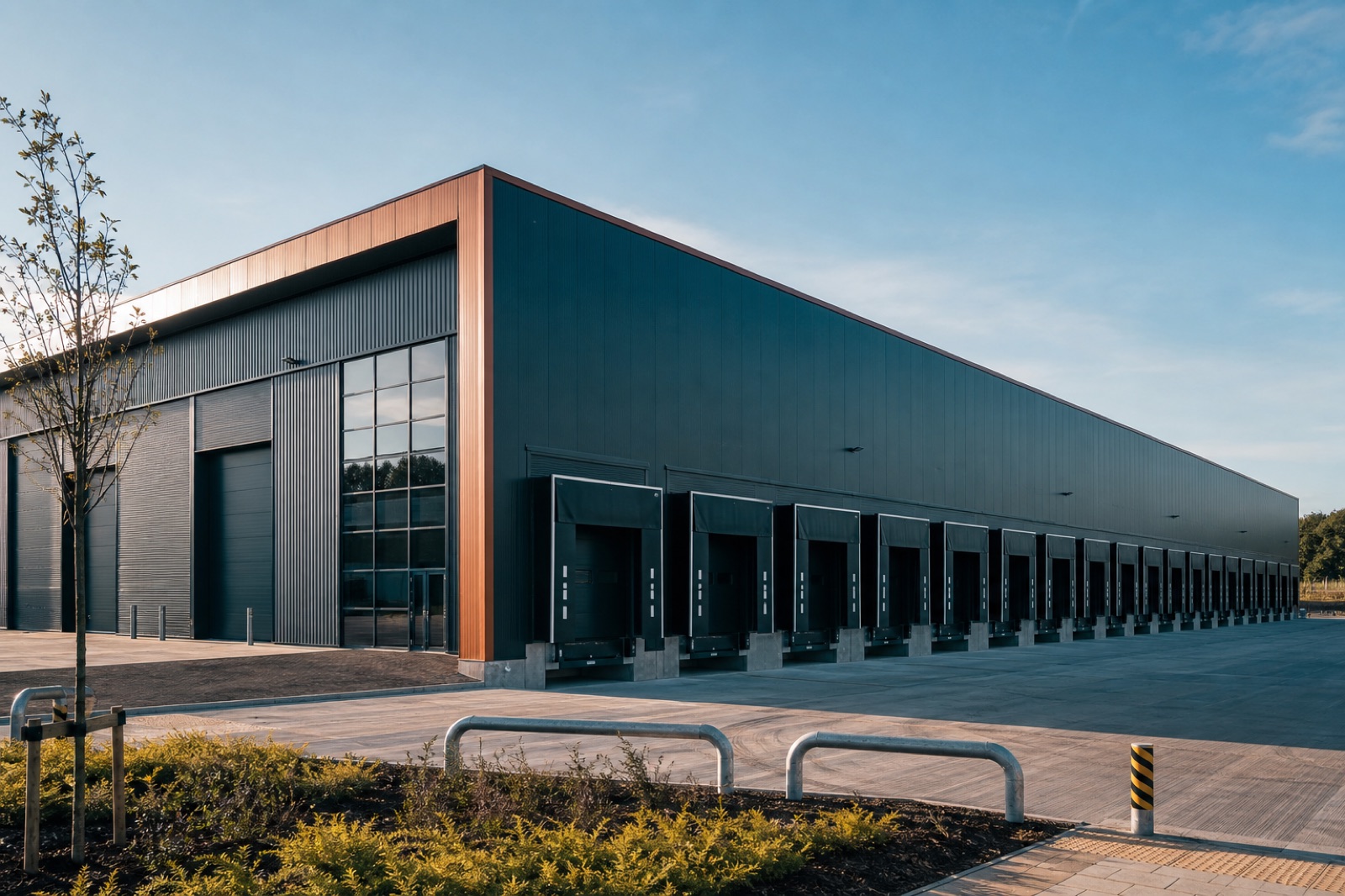
Industrial and logistics stabilisation finance: bridging speculative completion to stabilised occupancy
We arrange stabilisation finance for developers and investors carrying a speculative big-box or multi-let industrial scheme from practical completion through lease-up to stabilised occupancy. A speculative scheme completes with no income and leases up over 6 to 18 months, so stabilisation finance bridges practical completion to stabilised occupancy before a refinance onto long-term investment debt. This is finance against the scheme and its income, not a regulated mortgage on a home.

Stabilising industrial & logistics
Industrial and logistics property, spanning big-box distribution warehouses and multi-let industrial estates, is valued on its stabilised income once let to occupiers on institutional leases rather than on day-one bricks and mortar. A scheme built speculatively, without pre-lets, completes with no income at all, and the lease-up to stabilised occupancy is the defining financing question. Stabilisation finance is what funds that gap.
Stabilisation finance for industrial and logistics is the facility that bridges from practical completion through lease-up to stabilised occupancy. A speculative big-box or multi-let scheme completes with no income and leases up over roughly 6 to 18 months, so the bridge funds the asset until occupancy and rents are proven and the scheme can refinance onto long-term investment debt. It sits after development or development-exit debt and before a senior investment term loan or a sale.
Lenders underwrite an industrial stabilisation loan on the location, the depth of occupier demand, the building specification, the leasing strategy and the credibility of the exit, then size loan to value during lease-up and test the debt yield and interest cover the emerging rent roll supports. Strong rental growth and tight prime yields support the stabilised valuation: prime distribution trades at 5.00% on a 20-year net initial yield to 5.25% on a 15-year, with secondary at 6.00% (Knight Frank, Jan 2026), and prime big-box rental growth ran at 4.7% in the 12 months to end-2025 (JLL), against a five-year average of 6.8% (CBRE).
We present the scheme, the leasing plan and the rent evidence so stabilisation lenders can price the bridge, then structure the route onto investment term debt or a sale. Industrial and logistics was investors' preferred UK sector in 2025, with investment of about £8.7bn, up around 24% on 2024 (CBRE), and prime yields broadly stable; vacancy edged up to 7.1% on rising second-hand availability (CBRE, Q4 2025), which keeps lease-up risk on speculative space firmly in focus and the exit credible for well-located stabilised stock.
What we fund
- Speculative big-box distribution warehouses leasing up
- Multi-let industrial estates filling units over the ramp
- Schemes completing without pre-lets and no day-one income
- Development-exit cases needing time to reach stabilised occupancy
- Refurbished or repositioned industrial re-leasing
- Stabilised, let schemes refinancing onto investment debt
Indicative terms
- Loan to value (lease-up)Indicative ~65 to 75% during the ramp
- TermShort-dated, typically 6 to 18 months to let
- Debt yieldTested against the emerging rent roll
- Interest coverSized on net rent as units let
- Day-one to stabilisedBridge priced on the lease-up value gap
- Key testsLocation, occupier demand, spec, leasing plan, exit
- ExitInvestment term refinance or sale once let
Indicative only. Terms vary by lender, asset and scheme and are not an offer of finance.
How we arrange an industrial stabilisation bridge
We arrange the industrial stabilisation bridge around the lease-up curve and pre-agree the exit. For a speculative big-box or multi-let scheme that has just completed with no income we place a short-dated facility, indicatively around 65 to 75% of value during lease-up, that funds the asset while units let over roughly 6 to 18 months. Because a speculative scheme completes with no cash flow at all, interest is often rolled so debt service does not outrun the scheme's cash flow until units let and rent starts to flow. Where development or development-exit debt is maturing before the scheme is let, we refinance onto a stabilisation loan that buys time to lease up rather than forcing a sale at a vacant value, or place a second-charge facility behind retained senior debt where that keeps the cost of capital down. We size against the debt yield and interest cover the emerging rent roll supports, weigh the location, specification and depth of occupier demand, and structure the route onto a senior investment term loan or a sale. We frame every figure as indicative and never as an offer; the terms depend on the scheme, the leasing plan and the exit.
What lenders assess on an industrial scheme mid lease-up
Lenders underwrite an industrial stabilisation loan on the location and the depth of occupier demand, the building specification, the leasing strategy and the credibility of the exit, then size loan to value during lease-up and test the debt yield and interest cover the emerging rent roll supports. They weigh how rising second-hand availability affects the lease-up of speculative space, and they reward a well-located, well-specified scheme in a strong distribution market with keener terms. Specialist commercial bridging and stabilisation lenders, debt funds and challenger banks compete here, with the cheapest investment term debt arriving once the scheme is let. As a broker with no exclusive tie, we present the scheme and the leasing plan to the lenders most comfortable with industrial lease-up risk rather than steering every case to one name.
From stabilised occupancy to long-term investment debt
An industrial stabilisation loan is repaid once the scheme is let and occupancy is proven, at which point a stabilised valuation supports a senior investment term loan or a sale. Prime distribution trades at 5.00% on a 20-year net initial yield to 5.25% on a 15-year, with secondary at 6.00% (Knight Frank, Jan 2026), and prime big-box rental growth ran at 4.7% in the 12 months to end-2025 (JLL) against a five-year average of 6.8% (CBRE), so a let scheme converts a no-income day-one position into a materially higher stabilised value. Industrial and logistics was investors' preferred UK sector in 2025, with investment of about £8.7bn, up around 24% on 2024 (CBRE); vacancy edged up to 7.1% on second-hand availability (CBRE, Q4 2025). For a stabilisation lender, that depth of investor demand makes the refinance or sale a clear, well-evidenced exit.
Finance that suits this asset class
- Stabilisation bridge financeBridges a speculative industrial scheme from completion through lease-up to stabilised occupancy.
- Development exit financeRepays development debt at completion while units let up.
- Lease-up financeFunds the scheme while big-box or multi-let units fill to stabilisation.
- Bridge-to-term financeStructures the route from the lease-up bridge onto an investment term loan.
- Senior investment term loansLong-term debt on the stabilised, let scheme.
Stabilising industrial & logistics?
A view on fundability within one working day.
Frequently asked questions
What is industrial and logistics stabilisation finance?
Industrial and logistics stabilisation finance is a short-dated facility that bridges a speculative big-box or multi-let scheme from practical completion through lease-up to stabilised occupancy. A speculative scheme completes with no income and leases up over roughly 6 to 18 months, so the bridge funds the asset until occupancy and rents are proven and the scheme refinances onto long-term investment debt. It is finance against the scheme and its income, not a regulated home loan.
Can you get a mortgage on an industrial unit?
Yes, as commercial and investment finance rather than a residential mortgage. A let, income-producing unit is financed on a commercial mortgage or investment term loan, while a speculative scheme completing with no income needs stabilisation finance to bridge the lease-up before it qualifies for long-term debt. We size the bridge on loan to value, debt yield and interest cover against the emerging rent roll, and pre-agree the refinance exit.
How difficult is it to get a commercial mortgage on industrial property?
For a well-located, let industrial asset with institutional leases, finance is readily available in a sector that was investors' preferred UK choice in 2025 (CBRE). The difficulty arises with speculative space completing without pre-lets, which carries lease-up risk amid rising second-hand availability (vacancy 7.1%, CBRE, Q4 2025). Stabilisation finance bridges that lease-up; we run the lenders most comfortable with industrial lease-up risk and structure the route onto term debt.
Can I get a 100% commercial mortgage on industrial property?
No. Commercial and stabilisation lending is sized against value and income, not at 100%, with stabilisation leverage during lease-up commonly indicative of around 65 to 75% of value depending on the scheme, occupier demand and the exit. Lenders size against the debt yield and interest cover the rent roll supports. Additional capital above senior debt can sometimes be arranged through mezzanine or equity, but the senior loan is not full-value.
How much deposit is needed for industrial property?
Stabilisation finance funds a share of value, indicatively around 65 to 75% during lease-up, so the sponsor contributes the balance as equity, with the exact figure depending on the scheme, occupier demand and the exit. Lenders size leverage against the debt yield and interest cover the emerging rent roll supports rather than a fixed deposit percentage. We frame leverage as indicative only and never as an offer.
When is an industrial scheme stabilised?
An industrial or logistics scheme is treated as stabilised once it is let to occupiers on institutional leases and the income is proven rather than forecast, the point at which a valuer capitalises the income at a market yield and a long-term lender refinances the stabilisation bridge. With prime distribution at 5.00 to 5.25% (Knight Frank, Jan 2026), reaching stabilised occupancy is what converts a no-income day-one position into a refinanceable one.
Is industrial stabilisation finance a bridging loan?
Yes, it is a specialist commercial bridging loan written for the lease-up of a speculative big-box or multi-let scheme. It is short-dated and repaid from a defined exit, but the exit is stabilised occupancy and an investment term refinance or sale rather than a quick resale. We place it as a first charge or, where retained senior debt keeps the cost of capital down, as a second-charge facility behind it, usually rolling interest while the scheme has no income. We are a broker, not a lender, and frame every figure as indicative and never as an offer.
Stabilising industrial & logistics?
Tell us about the asset and the income plan and we will come back with a view on fundability and likely terms.